Monitoring Country

Cane toads

Cane toads are an invasive species that have been spreading across Australia since they were released in the 1930s. Cane toads are poisonous to the native species that eat them.
Cane Toads are a threat to native species
Cane toads produce a toxin that kills many native Australian animals, including mammals, reptiles, and birds, that attack or eat them. Cane toads have caused serious declines in species like northern quolls, freshwater crocodiles, and monitor lizards. Cane toads also compete for food and shelter with native frogs.
Can toads are listed as a declared pest in Western Australia. Other states usually have biosecurity restrictions or advice that must be followed.
‘The biological effects, including lethal toxic ingestion, caused by Cane Toads (Bufo marinus)’ is identified as one of the key threatening processes to native species under the Environmental Protection and Biodiversity Conservation Act. There is a National Threat Abatement Plan for cane toads.
Managing Cane Toads
Total eradication of Cane Toads is not currently possible because of how widespread they are across Australia and how quickly they are continuing to move. Best practice management of cane toads requires collaborations between government, researchers and land managers. Control methods for cane toads include:
- Toad musters - capture and humane killing of cane toads
- Conditioned taste aversion - teaching native predators like quolls and crocodiles to avoid eating cane toads
- Removing or restricting access to waterpoints or waterbodies
Species Records
Use the + - Zoom controls to select an area
Where they are
Cane toads can be easily confused with some native frogs – make sure you have correctly identified it as a cane toad before humanely killing. See the Department of Primary Industries and Regional Development Guide.
Cane toads are usually larger and stockier than native frogs. They have warty skin, large glands behind the ears, and ridges between the eyes and nostrils.
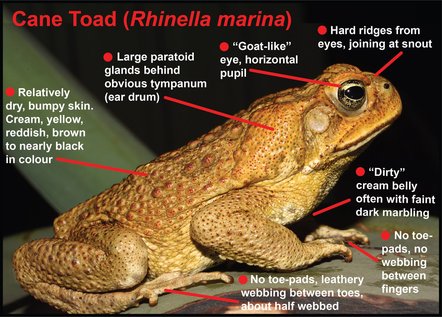
Cane toad with key identification features. Credit: Jodi Rowley/Australian Museum.
If you suspect you have found a cane toad ahead of the front line in Western Australia, please send a photo of the toad to the DBCA (Department of Biodiversity, Conservation, and Attractions) cane toad hotline on 0400 693 807. In partnership with land managers the department can then respond quickly before new populations become established.
What they sound like
Cane toads make a long, steady, trilling sound that is quite different from native frogs.
Listen to their call below (source The Australian Museum)
- Where cane toads do and don’t live
- How many cane toads live on Country
- How well management of Country and the cane toads is working
By using one or more the following methods, you can better understand cane toads on your Country. If you monitor the same place at the same time every year, you can see if there are changes to cane toads on Country.
Any time you do work that might disturb or interfere with native animals and vegetation, particularly threatened species, you need to check with the state authorities to see if you need any approvals, such as scientific licences or animal ethics committee permits.
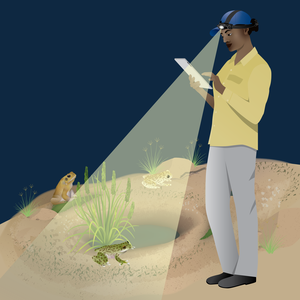

In general, if you record all frog species you learn:
- Biodiversity – what species of frog live on Country
- Species richness – how many different species of frog live on Country
- Presence/absence – if and where frog species live on Country
- Occupancy - If enough surveys are done at different places on Country, the presence/absence data can be used to estimate occupancy. This type of modelling helps to work how many places really have frog species, even if they weren’t seen or heard at every site.
- Activity – how many frogs are seen/heard during a survey. This can be used as an indicator of how large a population might be.
Spotlight and listen surveys are a useful tool for monitoring cane toads. Surveys involve looking for active cane toads at night with spotlights and also listening for their calls. Surveys can also involve call playback, which means playing pre-recorded cane toad calls and then listening to see if any in the environment respond by calling back. Surveys are relatively quick and easy, inexpensive, and less stressful for animals compared to other survey methods.
Spotlight & Listen Surveys are the best way to monitor cane toads, because they are active at night and their calls are distinct, and the surveys don’t need much equipment, software, or data processing like some other methods.
The best way to detect cane toads is to do this survey:
- at night
- in suitable habitat (around or near waterbodies, preferred habitats)
- peak active and calling periods (peak; December – February)
- in suitable weather conditions (warm, wet nights usually ideal)
- multiple times throughout the year
· It is important that the cane toads are correctly identified. Use reference materials like frog ID books/apps, and take photos and recordings of all frogs during the survey so you can double check the identification. It is also useful to get people to help on a survey who have experience with identifying cane toads, particularly from their calls.
A daytime visit to your survey site(s) can help you locate the best habitat to survey, the best way to access the site at night, and if you are planning to use transects, to mark out the survey points every 50 metres with reflective flagging tape or similar.
- Biodiversity – what species live on Country
- Species richness - how many different species live on Country
- Presence/absence – if and where cane toads (and other species) live on Country
- Occupancy - If enough surveys are done at different waterbodies on Country, the presence/absence data can be used to estimate occupancy. This type of modelling helps to work how many places really have cane toads (or other species), even if they weren’t detected at every site. This can be used as an indicator of how large a population might be and if is getting smaller/bigger over time
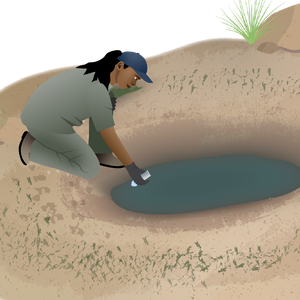
Environmental DNA (eDNA) monitoring involves taking water, soil, air, material, plant, or animal samples which can be identified or tested for genetic traces of animals from fur, skin, urine, faeces, sperm and/or eggs in the samples. eDNA sampling is relatively easy to do, causes less stress to animals than many other survey methods, and is good at finding animals that are difficult to see, hear, or catch. By taking water samples, eDNA sampling can be used to detect if cane toads are currently living in, or have been nearby or around, the waterbody recently.
eDNA water sampling can be a good method for monitoring cane toads, particularly if you’re not sure if they are on your Country yet, or if night spotlighting and listening surveys are challenging to do. The benefit of eDNA sampling is that you can usually detect a lot of species from the same sample, but be mindful that samples can take weeks or months to process.
When planning to do an eDNA monitoring survey:
- Collect samples when cane toads are more likely to have been in or using the water body, like in the wet season or breeding season
- Sampling needs to be done when there is water in the water body so might not be possible in the dry season or drought times.
- Take multiple water samples from within the same water body, spread out across the water body. This will depend on the size of the water body (e.g. a dam vs. a small creek line) and how accessible it is.
- Be aware that water bodies and water samples might contain hazardous things, like animal faeces, bacteria, or toxic substances (animal, plant, or human), so using gloves and good hand hygiene is important.
Primary sources
This landing page was developed using the following sources:
- PestSmart (2024). Cane toads. https://pestsmart.org.au/toolkits/cane-toads/
- Department of Climate Change, Energy, the Environment and Water (2024). Cane toads (Bufo marinus). https://www.dcceew.gov.au/environment/invasive-species/feral-animals-australia/cane-toads
- Department of Primary Industries and Regional Development, Western Australia. (2024), Cane toad. Department of Primary Industries and Regional Development, Perth. Factsheet DPIRD-172. https://library.dpird.wa.gov.au/bs_factsheets/77
- Shine, R. (2010). The ecological impact of invasive cane toads (Bufo marinus) in Australia. The Quarterly Review of Biology 85(3):253-291. https://www.jstor.org/stable/10.1086/655116
- Shine, R., Baeckens, S. (2023). Rapidly evolving traits enable new conservation tools: perspectives from the cane toad invasion of Australia. Evolution 77(8): 1744-1755. https://doi.org/10.1093/evolut/qpad102
- Kearney, M., Phillips, B.L., Tracy, C.R., Christian, K.A., Betts, G., Porter, W.P. (2008). Modelling species distributions without using species distributions: the cane toad in Australia under current and future climates. Ecography 31(4):423-434. https://nsojournals.onlinelibrary.wiley.com/doi/10.1111/j.0906-7590.2008.05457.x
- Western Australian Department of Biodiversity, Conservation and Attractions (2024). Cane toad management. https://www.dbca.wa.gov.au/management/threat-management/invasive-animals/cane-toad-management
- Australian Museum (2021). Cane toad. https://australian.museum/learn/animals/frogs/cane-toad/
- FrogID (2024). Rhinella marina. https://www.frogid.net.au/frogs/rhinella-marina
- Ward-Fear, G., Bruny, M., the Bunuba Rangers, Forward, C., Cooksey. I., Shine, R. (2024). Taste aversion training can educate free-ranging crocodiles against toxic invaders. Proceedings of the Royal Society B: Biological Sciences 291(2028): 20232507. https://royalsocietypublishing.org/doi/10.1098/rspb.2023.2507
Tools and resources
- Record frog calls and get help identifying calls using the Australian Museum’s FrogID app - https://www.frogid.net.au/
- Record sightings and control activities of cane toads using the ToadScan app - https://www.feralscan.org.au/toadscan/
- See the Toad Containment Zone Project for information about preventing the spread of cane toads further west into the Pilbara
Webpage version: GA-JH-JH-04052026