Monitoring Country

Spotlight & Listen Surveys for Frogs
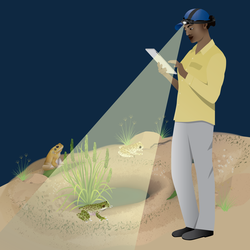
Spotlight and listen surveys are a useful tool for monitoring frogs. The surveys involve:
- Looking for active frogs at night with spotlights and
- Listening for frogs that are calling
Surveys can also involve call playback, which means playing pre-recorded frog calls and then listening to see if any frogs in the environment respond by calling back.
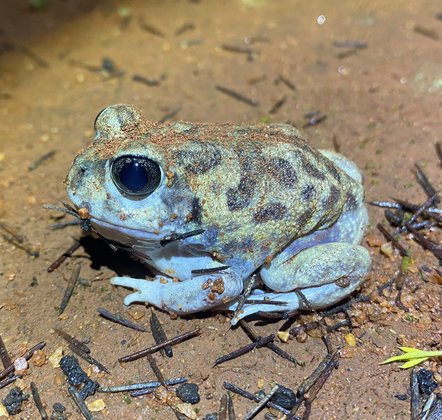
Burrowing frog seen during a spotlight survey. Credit: Josh Hungerford.
Less stress for animals: Spotlight and listen surveys don’t involve catching and handling frogs. Animals are often stressed if they are caught and handled by people. Handling frogs can also spread disease, such as Chytrid fungus which can kill frogs.
Inexpensive: Spotlight and listen surveys don’t need highly specialised or expensive equipment. Some headtorches can be over $200 but cheaper headtorches can still be used.
Quick and flexible: Spotlight and listen surveys don’t require much effort and can be done quickly and opportunistically when the weather conditions are suitable.
What can spotlight & listen surveys monitor?
You can use Spotlight & Listen surveys to monitor frog species that are active and calling on Country.
What can you learn?
- Biodiversity – what species of frog live on Country
- Species richness – how many different species of frog live on Country
- Presence/absence – if and where frog species live on Country
- Occupancy - If enough surveys are done at different places on Country, the presence/absence data can be used to estimate occupancy. This type of modelling helps to work how many places really have frog species, even if they weren’t seen or heard at every site.
- Activity – how many frogs are seen/heard during a survey. This can be used as an indicator of how large a population might be.
If you monitor at the same place at the same time every year, you can see if there are changes to frog populations living on Country. You can look at changes over time and decide if your management of Country is working well.
What can’t you learn?
- Population size – the number of calls heard, or frogs seen, doesn’t always tell you how many animals are actually living there.
- Which species aren’t living on Country - some species of frog might not be calling when you do your survey, they might live in a different habitat type, or might change their behaviour because you are in their habitat.
Using spotlight & listen surveys the Right-way
The best way to detect frog species is to do this survey:
- at night
- in suitable habitat (around or in waterbodies)
- peak active and calling periods (breeding season)
- in suitable weather conditions (warm, wet nights for some species, cool, wet nights for others, still or light wind conditions)
- multiple times throughout the year
It is important that the frogs are correctly identified. Use reference materials like frog ID books, and take photos and recordings of frogs during the survey so you can double check the identification. It is also useful to get people to help on a survey who have experience with identifying frogs, particularly from frog calls.
A daytime visit to your survey site(s) can help you locate the best habitat to survey, the best way to access the site at night, and if you are planning to use transects, to mark out the survey points every 50 metres with reflective flagging tape or similar.
Frog biodiversity monitoring
Frogs can be monitored with spotlight and listen surveys to find out frog biodiversity, species richness, presence/absence, occupancy and activity. Plan to do this survey when most of the species are active and calling, and/or do the survey several times throughout the year and/or do the survey in several different habitat types.
You can learn more on the Things We Care About page and in the Environmental Monitoring Method Frog Spotlight & Listen Surveys.
Targeted frog species monitoring
If you are interested in a specific species of frog, you can use spotlight and listen surveys to find out presence/absence, occupancy and activity. Plan to do this survey when the target species is active and calling (breeding season) and in its preferred habitat.
You can learn more on the Things We Care About page and in the Environmental Monitoring Method Frog Spotlight & Listen Surveys.
Cane Toad monitoring
If you are interested in monitoring Cane Toads, you can use spotlight and listen surveys to find out about presence/absence, occupancy and activity. Plan to do this survey when Cane Toads are active and calling (breeding season) and when they are easiest to find in their preferred habitat (e.g. waterbodies that hold water all year round).
You can learn more a on the Things We Worry About page and in the Environmental Monitoring Method Frog Spotlight & Listen Surveys.

Primary sources
This landing page was developed using the following sources:
- Department of Planning, Industry & Environment (2020). NSW Survey Guide for Threatened Frogs. Department of Planning, Industry & Environment, Parramatta NSW
- Department of the Environment, Water, Heritage and the Arts (2010). Survey guidelines for Australia’s threatened frogs. Commonwealth of Australia.
- Durkin, L., Chick, R., Molloy, J. (2023). Forest Protection Survey Program: Survey Guideline Frog Survey (V. 5.0). State of Victoria Department of Energy, Environment and Climate Action.
- Office of Environment and Heritage. Eradicating cane toads in NSE outside their current range distribution. Best practice guidelines. Office of Environment and Heritage, Sydney NSW
- Brown, G. P. & Shine, R. (2016). Frogs in the spotlight: a 16-year survey of native frogs and invasive toads on a floodplain in tropical Australia. Ecology and Evolution 6(13):4227-4602.
Tools and resources
- Record frog calls and get help identifying calls and frogs using the Australian Museum’s FrogID app
- EMSA standardised survey methods: Fauna Ground Counts Module.
Webpage version: GA-CM-JH-GA-140426