
Monitoring Country

Gouldian Finch
 Endangered
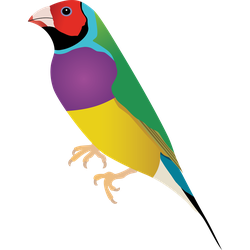
Gouldian Finches are small, brightly multi-coloured birds that can be alone, in small family groups or flocks all the way up to hundreds of birds. As a type of grassfinch, they feed on grass seeds and insects.
Conservation status
- National – Endangered
- NT – Vulnerable, QLD – Endangered
There is a national recovery plan for the Gouldian Finch. The recovery plan helps people know what management and research is needed to best look after Gouldian Finch.
Where Gouldian Finches live
Species Records
Use the + - Zoom controls to select an area
Gouldian Finches are found across northern Australia northern parts of the Northern Territory and the Kimberley in Western Australia, and patches of Cape York Peninsula in Queensland.
They are partly migratory – they move from more coastal areas in the dry season, and then return inland to breed during the wet season.
Habitat
Gouldian Finches will be found nearby freshwater on the edges of mangroves and thickets, or in savannahs with hollow-bearing trees.
During breeding season (January to April), they are found in savannah woodlands:
- with rocky hills
- with hollow-bearing smooth-barked Eucalyptus trees
- 2-4 km away from water
Where Gouldian Finches eat
During the dry season Gouldian Finches mostly eat spear grass or native sorghum seeds, with recently burnt undergrowth making it easier to find seed. During the wet season Gouildian finches mostly eat cockatoo grass (Alloteropsis semialata), golden bear grass (Chysopogon fallax) or spinifex (Triodia) or other grasses like giant spear grass, white grass, ricegrass and kangaroo grass, in areas not burnt in the last dry season.
What Gouldian Finches look like
Gouldian Finches have a bright green back, yellow belly and purple breast. They have a black, red or yellow face. Male and females look very similar except that males are more brightly colour. Juvenile birds are mostly olive-grey coloured.

Gouldian Finch (Chloebia gouldiae). Credit: Kym Nicolson, CC-BY-4.0 (Int).
What Gouldian Finches sound like
Gouldian Finches are mostly quiet, but will occasionally make a high-pitched whistling.
Threats
Some of the key threats to the Gouldian Finches include:
- Unhealthy Country or lost habitat caused by:
- Wrong-way fire
- livestock and feral herbivores like cattle and feral pigs

REMEMBER! Any time you do work that might disturb or interfere with native animals and vegetation, particularly threatened species, you need to check with the state authorities to see if you need any approvals, such as scientific licences or animal ethics committee permits.
You can monitor Gouldian Finch to better understand:
- Where they do and don’t live
- How many live on Country
- How well management of Country and Gouldian Finch is working
By using one or more the following methods, you can better understand Gouldian Finch on your Country. If you monitor the same place at the same time every year, you can see if there are changes to Gouldian Finch on Country.
eDNA water monitoring
Environmental DNA (eDNA) water monitoring involves taking water samples from a waterbody and getting the sample analysed to see if a Goudian Finch is or has recently been in a waterbody. This method is useful for Gouldian Finch because they are cryptic species, meaning they can be difficult to see and catch.
What can you learn?
- Presence or absence of Gouldian Finch in a waterbody
Using it the Right-way
Collect samples in the late dry season when they spend more time in waterholes because they can’t get their water from other places.
Collect samples from waterholes that are nearby their preferred dry season habitats and still have water in them in the late dry season.
You can learn more about the eDNA monitoring on the “How we check on things” page and in the Environmental Monitoring Method eDNA Water Sampling with EnviroDNA Kits.
Waterhole Count
Waterhole counts involve visiting a waterhole in the morning several days in a row and counting how many Gouldian Finches are seen using the waterhole. This method is useful for Gouldian Finch because it is an easy way to check if Gouldian Finches are using a waterhole, but the data doesn’t have much statistical power.
What can you learn?
- Presence/Absence – if and where Gouldian Finches live on Country
- Activity – how many Gouldian Finches are seen/heard during a survey. This is sometimes used as an indicator of how a population is doing over time, but it isn’t very reliable measure of population trends for Gouldian Finch.
Using it the Right-way
Survey waterhole in the late dry season when Gouldian Finch spend more time in waterholes because they can’t get their water from other places.
Survey waterholes that are nearby their preferred dry season habitats and still have water in them in the late dry season.
Each waterhole count lasts for three hours and Gouldian Finches get scared off by movement or sound, so you need to be able to sit quietly and very still for the length of the survey.
You can learn more about waterhole counts in the Environmental Monitoring Method Gouldian Finch Waterhole Count.
2 Ha 20 Minute Bird Survey
2 ha (hectare) 20 minute Bird Surveys involve visiting many sites, ideally in different habitat types and for several mornings in a row, and counting how many Gouldian Finch and all other bird species you can see or hear inside the 2 ha area and within the 20 minutes. This method is useful for surveying entire bird communities on Country. It can collect a lot of data, and if designed well, can have strong statistical power.
What can you learn?
- Presence/Absence – if and where Gouldian Finch and other bird species live on Country
- Activity – how many Gouldian Finch and other bird species are seen or heard during a survey. This is sometimes used as an indicator of how a population is doing over time, but it isn’t very reliable measure of population trends
- Occupancy - the proportion of sites occupied by a species.
- Changes over time – are species being detected at the same sites every year, or are they disappearing from some and/or appearing at other sites?
- Habitat preferences – does the species only occur in particular habitats?
- Detection frequency – how often are they being detected in an area?
Using it the Right-way
- Try to make the 2 ha area only one habitat type, so that data can be analysed for patterns between habitat types
- Try to walk around slowly and quietly to not disturb the birds, otherwise they might fly away or hide
- Try to not count the same individual birds twice, or count birds outside of the 2 ha area, otherwise the analysis will think there are more birds than there really are
- Some birds are quiet and some are loud, some birds move a lot and others don’t, so both looking and hearing is best
You can learn more about bird surveys on the “How we check on Things” in the Environmental Monitoring Method 2 ha 20min Area Search for Terrestrial Birds.
Any time you do work that might disturb or interfere with native animals and vegetation, particularly threatened species, you need to check with the state authorities to see if you need any approvals, such as scientific licences or animal ethics committee permits.
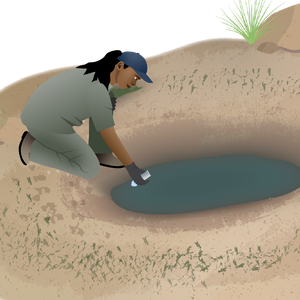


Less stress for animals: eDNA sampling doesn’t involve catching, handling or getting close to animals. Animals are often stressed if they are caught and often change their behaviour when people are around.
Find what you miss: eDNA can detect animals that have passed through the area that are …
Primary sources
This landing page was developing using the following sources:
Primary sources
This landing page was developing using the following sources:
- Australian Museum (2025). Gouldian Finch. https://australian.museum/learn/animals/birds/gouldian-finch/
- O’Malley, C. (2006). National Recovery Plan for the Gouldian Finch (Erythrura gouldiae). WWF-Australian & NT Department of Natural Resources, Environment and the Arts. https://www.dcceew.gov.au/environment/biodiversity/threatened/recovery-plans/national-recovery-plan-gouldian-finch-erythrura-gouldiae
Tools and resources:
- BirdLife (2025). How to do a 2 hectare, 20 minute Standardised Area Search. Birdata: BirdLife. Birdata How To Do A 2 Hectare, 20 Minute Standardised Area Search
- BirdLife. How to choose a survey type: How to survey with Birdata. Birdata: BirdLife. 'How-to' Guides - Birdata