Monitoring Country

Feral camels
Camels are humped. hooved mammals that are well-adapted to living in desert environments. While they are a domesticated breed, they are considered a feral species in Australia. Camels were introduced to Australia as domesticated animals in 1840, but when camels were replaced by vehicles (1920-1930) thousands were released into the bush. There are now estimated to be about 1 million feral camels in Australia.
Camels are a threat to healthy Country and native species
Feral camels harm Country because their grazing behaviour can be destructive, including eating rare and threatened flora, trampling native plants, and damaging waterways, leading to:
- Water pollution and changed water flows
- Decline or loss of native plant species
- Soil compaction and erosion
Damage to vegetation and waterways is particularly bad during drought (dry) years. Feral camels also compete for food resources with native grazers like kangaroos and other marsupials.
Feral camels are listed as a declared pest in Western Australia. Under the Australian Pest Animal Strategy, feral camels are considered an Existing Pest Animal of National Significance. There is a National Feral Camel Action Plan.
Managing Camels
Total eradication of Feral Camels will be difficult to achieve because there are so many of them and they move large distances across the more remote parts of Australia.
Feral Camel management includes protecting important areas like waterways and native vegetation with fencing. However, the main control methods for Feral Camels currently are ground culling by trapping and mustering at water points and aerial culling.
Species Records
Use the + - Zoom controls to select an area
Where they are
Camels are large mammals, up to 700 kg and 2 metres tall. Key features include:
- Long, curved neck
- A large hump on their back
- Sandy-brownish coloured and sometimes shaggy fur
- Rounded, cushioned hooves for walking on soft sand
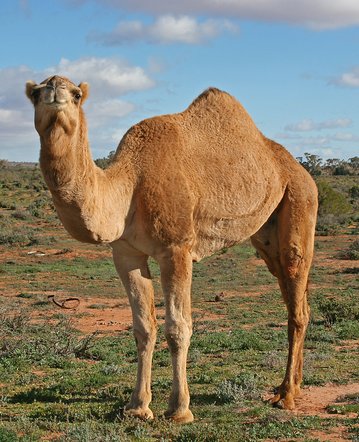
Feral dromedary camel. Credit: John O’Neill.
Scats
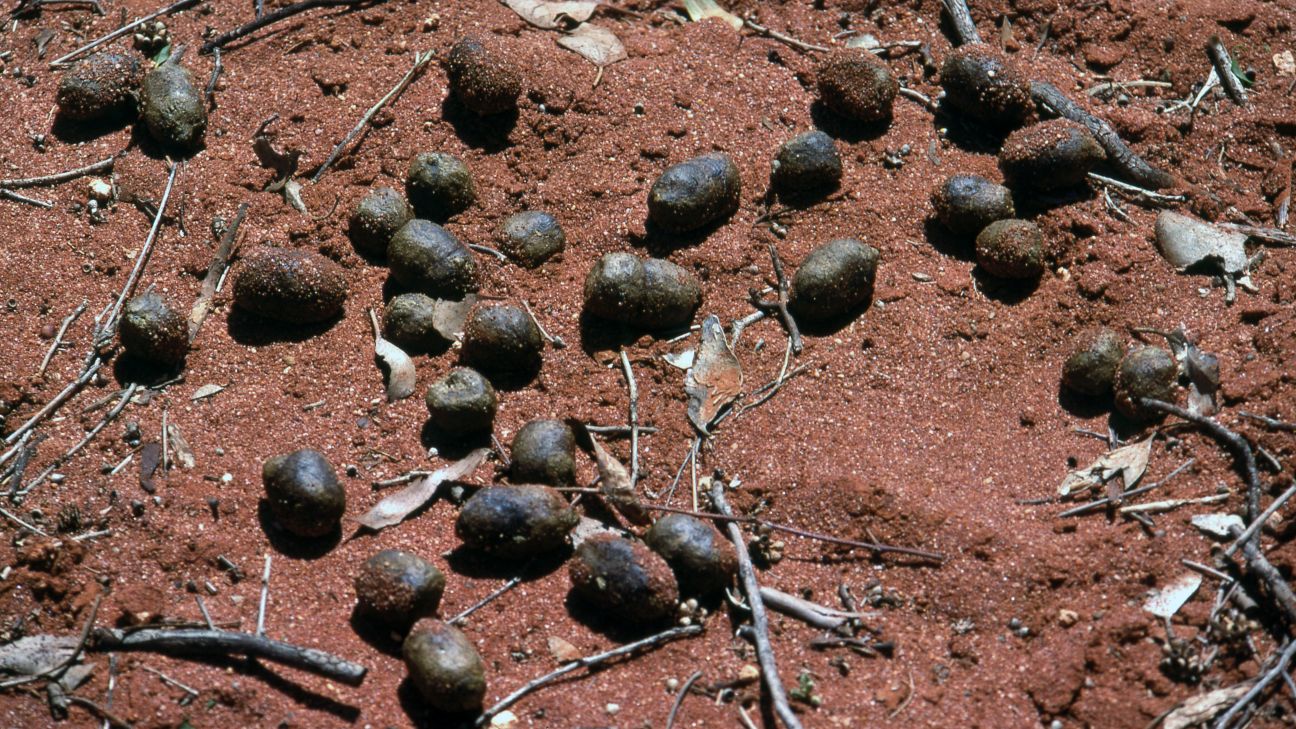 Feral dromedary camel scats. Credit: Department of Environment, Tourism, Science, and Innovation.
Tracks
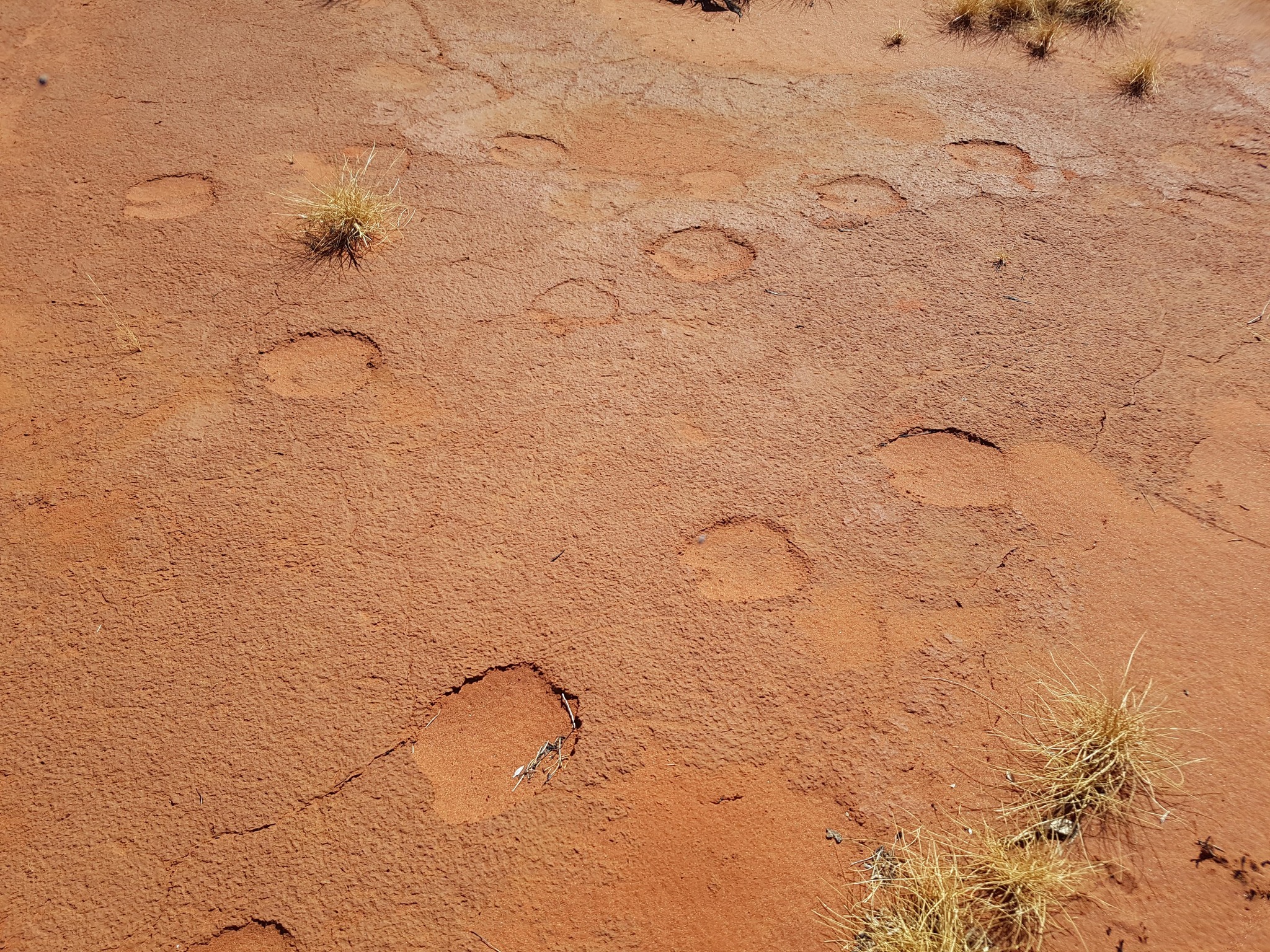 Feral dromedary camel tracks. Credit: Deborah Metters.
- where feral camels do and don't live
- how many feral camels live on your Country
- how well management of Country and feral camels is working
If you monitor the same place at the same time every year, you can see if there are changes to feral camels on Country.
Any time you do work that might disturb or interfere with native animals and vegetation, particularly threatened species, you need to check with the state authorities to see if you need any approvals, such as scientific licences or animal ethics committee permits.
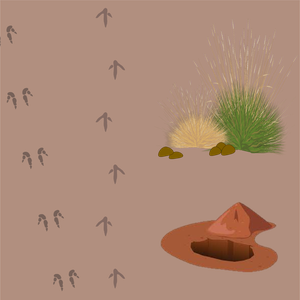

- Presence/absence – if and where feral camels live on Country
- Occupancy - if enough plots are surveyed, the presence/absence data can be used to estimate occupancy. This type of modelling helps to work how many areas really have feral camels, even if they weren’t detected at every plot. This can be used as an indicator of how large the population might be and if is getting smaller/bigger over time.
- Activity - how many signs of feral camels were detected during the survey. This can be used as an indicator of how large the population might be.
- Population size – if enough fresh scat can be collected and sent off for genetic analysis, the information can be used in a capture-recapture analysis to estimate how many feral camels live on Country.
2 Ha Plot Surveys can be used to monitor feral camels on Country. This is a method where trackers search a 2 Hectare (Ha) area for all signs of animals, including tracks, scats, diggings and other signs. If signs of a species are found in a plot, its presence is recorded. This method doesn’t usually focus on a single species as you can often record signs of many species. This survey doesn’t need specialised equipment, but it is useful to have some tracking skills, particularly when trying to identify challenging signs like diggings.
2 Ha Plot Surveys are a great way to monitor feral camels because their tracks are easy to identify, and it’s an easy survey method, compared to something like aerial surveys. 2 Ha Plot Surveys can also be combined with camera surveys in an area to get more data on feral camels.
When planning to do a 2 Ha Plot Survey:
- Feral camel tracks can be difficult to tell apart from cattle tracks. Feral camel tracks are typically larger, wider, and more rounded compared to cattle tracks.
- Feral camel scats can sometimes be difficult to tell apart from goat scatsw
- 2 Ha Plot Surveys are most suitable for sandy Country, where tracks will easily show up
- Where feral camels live:
- Occupancy – the proportion of sites occupied by a species.
- Changes over time – are species being detected at the same sites every year, or are they disappearing from some and/or appearing at other sites?
- Habitat preferences – does the species only occur in particular habitats?
- Detection frequency – how often are they being detected in an area?
- Behaviour – what are they doing in the photos?
- Activity – you can know when they are active or passing through areas. This can also be used as an indicator of how large the population might be
- You can collect data from seeing feral camels in an image. You might be able to identify their age, sex, group size, health (skinny or fat) etc
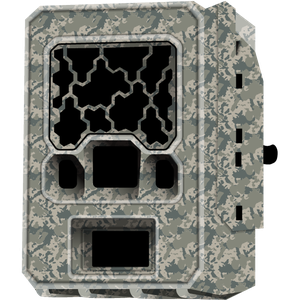
Camera traps can be used to monitor feral camels on Country. They can be set to automatically take photos or videos when an animal passes the camera. You can make your monitoring more efficient and cost effective by monitoring multiple species (including native and introduced species) with this method.
You will need to buy good quality remote cameras, but not much training is needed for deploying cameras or identifying species in the images. Images can also be processed first with the use of artificial intelligence (AI) tools, which can be useful when you have large numbers of images.
Cameras can be a great way to monitor feral camels if you know, or are fairly confident that, they are on your Country. Feral camels are easily identifiable from camera images. You can put out lots of cameras and cover large areas, increasing the chance that you will detect them.
When planning to do a camera survey:
- Feral camels use lots of different habitat types, so make sure the cameras are spread across all of the different major habitat types found on Country. If possible, have replicates in each habitat type.
- Use cameras in areas suitable for camera trapping i.e. open enough to take photos, or along trails, good access
- Avoid putting cameras in areas prone to flooding or becoming seasonally inaccessible, or make sure you collect cameras before it becomes inaccessible
- Feral camels are generally diurnal
- If there is an obvious path or area that feral camels use, you can set up cameras to face this path. Angle the camera down the path, so that you increase the amount of time the camera has to take pictures as feral camels pass by.
- Feral camels have a large body, so should easily trigger the camera sensors. If you use the standard camera trapping set up (height of 30 - 40 cm from ground) to monitor them you might only see their legs or lower half, so consider increasing the height to ~ 1 m, but be mindful that this might mean you won’t see some smaller animals easily
- Whenever possible, proof image classifications (including images with “nothing” in them), especially when using AI.
Primary sources
This landing page was developed using the following sources:
- Atlas of Living Australia. Camelus dromedarius. Camelus dromedarius : Camel | Atlas of Living Australia
- Saalfeld, W.K., Edwards. G.P. (2010). Distribution and abundance of the feral camel (Camelus dromedarius) in Australia. The Rangeland Journal 32:1-9. https://www.publish.csiro.au/rj/pdf/RJ09058
- Department of Sustainability, Environment, Water, Population and Communities (2010). National Feral Camel Action Plan: A national strategy for the management of feral camels in Australia. Commonwealth of Australia: Barton, ACT. https://www.dcceew.gov.au/environment/invasive-species/publications/national-feral-camel-action-plan
- PestSmart (2024). Feral Camels. https://pestsmart.org.au/toolkits/feral-camels/
- Northern Territory Government (2024). Feral Camel. https://nt.gov.au/environment/animals/feral-animals/feral-camel
- Saalfeld, W.K., Edwards, G.(2008) ‘Chapter 2: Ecology of feral camels in Australia’. In Managing the impacts of feral camels in Australia: a new way of doing business (DKCRC Report 47) (Eds. G.P. Edwards, B. Zeng, W.K. Saalfeld. P. Vaarzon-Morel, M. McGregor). Desert Knowledge Cooperative Research Centre: Alice Springs, NT. https://www.nintione.com.au/resources/rao/chapter-2-ecology-of-feral-camels-in-australia/
- Box, J.B., McBrunie, G., Strehlow, K., Guest, T., Campbell, M., Bubb, A., McConnell, K., Willy, S., Uluru, R., Kulitja, R., Bell, B., Burke, S., James, R., Kunoth, R., Stockman, B. (2016). The impact of feral camels (Camelus dromedarius) on remote waterholes in central Australia. The Rangeland Journal 38:191-200. https://www.publish.csiro.au/rj/pdf/RJ15074
- El Allali et al. (2022). Sleep pattern in the dromedary camel: a behavioural and polysomnography study. Sleep 45(8), https://doi.org/10.1093/sleep/zsac101.
Tools and resources
-
Record Feral Camel sightings and activity on the FeralScan app: https://feralscan.org.au/otherpests/default.aspx