Monitoring Country

Antilopine Kangaroo

Kangaroos are large, herbivorous marsupials with powerful hind legs that allow them to hop at great speeds. They can be solitary or social.
| Aboriginal Name | Language Group |
|---|---|
| A-Garndalpburru | Ngandi |
| A-Garrtjjambal | Ngandi |
| Arrjambal | Wubuy |
| Barlingama | Marra |
| Gandakkitj | Rembarrnga |
| Gandayala | Rembarrnga |
| Garndalburru | Alawa |
| Garndalpburru | Ngalakgan |
| Garndalppurru | Rembarrnga |
| Garnrdarlburru | Marra |
| Garrjambal | Rembarrnga |
| Garrtjambal | Ritharrŋu |
| Jaganda | Marra |
| Jardugal | Ngalakgan |
| Plein Keingguru | Kriol |
| Yarrgarla | Alawa |
Species Records
Use the + - Zoom controls to select an area
Where are antilopine kangaroos found
They have short reddish tan fur and a whitish belly and cheeks. Females are greyer on the head, neck and shoulders. Male kangaroos are usually larger than females and can reach 49 kg.

Scats
Most big kangaroos have scats that look similar. They are usually shaped like uneven little balls that are about 1-3 cm depending on the size of the kangaroo. The inside is dry and made up of grass and leaves.
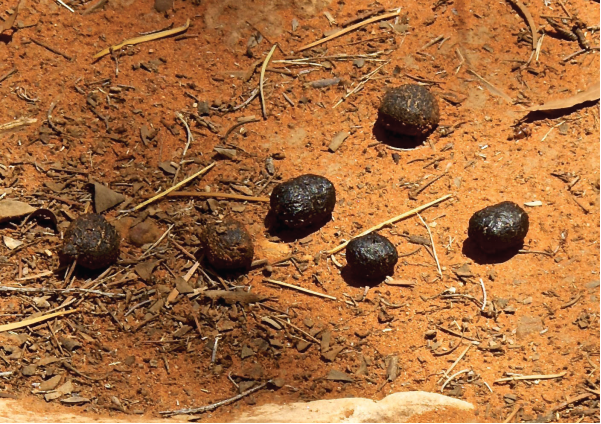
Euro scats (all large kangaroos have similar scats). Credit: Norman Jackson
Tracks
Big kangaroos either hop on two feet or walk on all fours, so they can leave two different types of tracks. They sometimes use their tails for balance.
Front feet - 5 forward pointing, clawed toes.
Back foot - long with 4 toes. Only 2 toes touch the ground when the kangaroo moves. Both toes have strong claws, and 1 is much longer.
A clear track can be used to identify the species based on the different shapes of foot pads.
Species distribution is helpful in identifying tracks. Size differences between kangaroos are not always useful because females can be much smaller than males of the same species.
Conservation Status
Antilopine kangaroos are not considered threatened.
They can be a threat to other species when they are overpopulated. When too many kangaroos live in an area, they can degrade the environment and compete with other species by stripping the landscape of vegetation.
Kangaroos are managed and protected under each Australian state and territory’s laws and regulations. Seek advice from the relevant state or territory government department for specific information.
You can monitor Antilopine Kangaroos to better understand:
Where they do and don’t live
How many live on Country.
How well management of Country is working
You can see if the number of kangaroos is going up, down, or staying the same. You might need to monitor kangaroo population trends to:
Check if numbers are decreasing
If hunted in your area, numbers may decrease. Overhunting might make numbers very low.
Drought, or other environmental changes might cause numbers to decrease.
Check if they are becoming overpopulated.
This may be a trigger for management of kangaroo populations on your land.
By using one or more the following methods, you can better understand Antilopine Kangaroos on your Country. If you monitor the same place at the same time every year, you can see if there are changes to Antilopine Kangaroos on Country.
Any time you do work that might disturb or interfere with native animals and vegetation, particularly threatened species, you need to check with the state authorities to see if you need any approvals, such as scientific licences or animal ethics committee permits.

Where Antilopine Kangaroo live:
Occupancy – the proportion of sites occupied by a species.
Changes over time – are species being detected at the same sites every year, or are they disappearing from some and/or appearing at other sites?
Habitat preferences – does the species only occur in particular habitats?
Detection frequency – how often are they being detected in an area?
Behaviour – what they are doing in the photos?
Activity – You can know when they are active or pass through areas. This can also be used as an indicator of how large the population might be.
You can collect data from seeing Antilopine Kangaroo in an image. You might be able to identify their age, sex, group size, health (skinny or fat
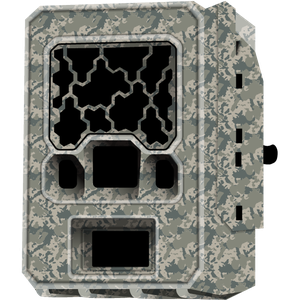
Camera traps can be used to monitor Antilopine Kangaroos. They can be set to automatically take photos or videos when an animal passes the camera. You can make your monitoring more efficient and cost effective by monitoring multiple species (including native and introduced species) with this method.
You will need to buy good quality remote cameras, but not much training is needed for deploying cameras or identifying species in the images. Images can also be processed first with the use of artificial intelligence (AI) tools, which can be useful when you have large numbers of images.
Animals use lots of different habitat types, so make sure the cameras are spread across all of the different major habitat types found on Country. If possible, have replicates in each habitat type.
Use this method in areas suitable for camera trapping i.e. open enough to take photos or along trails, good access.
Avoid putting cameras in areas prone to flooding or become seasonally inaccessible, or make sure you bring in cameras before it becomes inaccessible.
Kangaroos are generally nocturnal but can be active at all times of day.
If there is an obvious path or area that kangaroos use, you can set up cameras to face this path. Angle the camera down the path, so that you increase the amount of time the camera has to take pictures as kangaroos pass by.
Kangaroos have a large body, so should easily trigger the camera sensors. You can use the standard camera trapping set up (height of 30 - 40 cm from ground) to monitor them.
Place cameras 1 km apart.
Whenever possible, proof image classifications (including images with “nothing” in them), especially when using AI.
Find out if kangaroos are present on country at that time.
Find out where on country they are and aren’t present.
If you do the survey over multiple years (and at the same time of year):
See if the number of sites that kangaroos are present are going up or down.
Check how well your management is working.
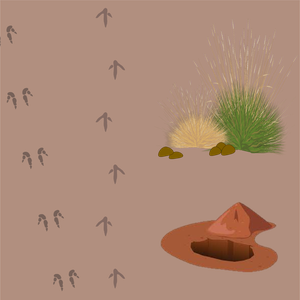
This is a method where trackers search a 2 Ha area for all signs of animals, including tracks, scats, diggings and other signs. If signs of a species are found in a plot, its presence is recorded. This method doesn’t focus only on kangaroos, as the presence of all species is recorded.
You can use tracking skills to collect data, and you don’t need to catch animals or use special equipment.
By using these standardised methods, you can choose to share your data with the ‘Arid Zone Monitoring’ project. This program gather’s data and uses it to map the distributions of desert species and look for trends in abundance over time. Ultimately, the project’s aim was to create national-scale monitoring for desert wildlife and showcase the work being done in the deserts, especially by Indigenous ranger groups. Contact Sarah Legge at AridZoneMonitoring@gmail.com if you are interested in sharing data.
Primary sources
This landing page was developing using the following sources:
This landing page was developing using the following sources:
The Arid Zone Monitoring Project’s Species Profiles www.aridzonemonitoring.org.au
Menkhorst, P., & Knight, F. (2011). A Field Guide to the Mammals of Australia (Third). Oxford University Press.
Triggs, B. E. (2004). Scats Tracks and Other Traces: a field guide to Australian mammals. Oxford University Press.
Menkhorst, P., & Knight, F. (2011). A Field Guide to the Mammals of Australia (Third). Oxford University Press.