Monitoring Country

Sand Goanna
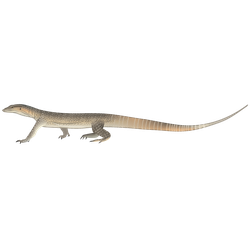
Sand Goannas are large lizards that can be more than 1 metre long. They look similar to other large goannas. Sand Goannas are the most common goanna in Australia and are found in many different habitat types. They have strong claws for digging large, deep burrows.
Where Sand Goannas live
Species Records
Use the + - Zoom controls to select an area
Widespread across most of Australia. They are typically not found in cold, wet forests of southern Australia.
Habitat
Sand Goannas are found in many different habitat types including woodlands, shrublands, grasslands, deserts and rocky areas.
Where they sleep
Sand goannas dig large, deep burrows for shelter, but will also use hollow logs, rock crevices and dense litter.
What Sand Goannas look like
Sand Goannas are one of the larger goannas in Australia. Their pattern and colours can be very different, ranging from light yellow to blackish brown with dense dark speckling and pale spots. They have a dark stripe from the eye, and narrow yellow bands along the tail with a yellow tip.
Yellow-spotted Goanna (Varanus panoptes) look similar but are more robust than Sand Goannas.
Yellow-spotted Goanna and Perentie (Varanus giganteus) tracks look similar but generally leave a straighter tail mark and have larger footprints than Sand Goannas.

Sand Goanna (Varanus gouldii). Credit: Peripitus, CC-BY-SA-3.0.
What Sand Goannas eat
Sand Goannas are carnivorous. They will scavenge on carrion (dead animals) as well as hunt for live animals.
Threats
Sand Goannas aren’t considered a threatened species but predation by Foxes and poisoning by eating Cane Toads are an issue in some parts of Australia.
REMEMBER! Any time you do work that might disturb or interfere with native animals and vegetation, particularly threatened species, you need to check with the state authorities to see if you need any approvals, such as scientific licences or animal ethics committee permits.
You can monitor Sand Goannas to better understand:
- Where Sand Goannas do and don’t live
- How many Sand Goannas live on Country
- How well management of Country and Sand Goannas is working
By using one or more the following methods, you can better understand Sand Goannas on your Country. If you monitor the same place at the same time every year, you can see if there are changes in Sand Goannas on Country.
2 Ha Plot: Tracks, Scats, Diggings & Signs Survey
A good way to monitor Sand Goannas is by searching 2 ha areas for all signs of Sand Goannas, including tracks. This survey doesn’t need specialised equipment but it is useful to have some tracking skills and practice differentiating between different types of Goanna. The survey records information on any animals that leave behind signs.
What can you learn?
- Presence/absence – if and where Sand Goannas live on Country
- Occupancy - If enough plots surveyed, the presence/absence data can be used to estimate occupancy. This type of modelling helps to work how many places really have Sand Goannas, even if they weren’t detected at every plot. This can be used as an indicator of how large the population might be and if is getting smaller/bigger over time.
- Activity - how many signs of Sand Goannas were detected during the survey. This can be used as an indicator of how large the population might be.
- Population size – if the scat is collected and sent off for genetic analysis, the information can be used in a mark-recapture analysis to estimate how many Sand Goannas live on Country
Using it the Right-way
You can learn more about the 2 Ha Plot method on the “How we check on things” page and in the Environmental Monitoring Method 2 Ha Plot: Tracks, Scats, Diggings & Signs Survey.
Any time you do work that might disturb or interfere with native animals and vegetation, particularly threatened species, you need to check with the state authorities to see if you need any approvals, such as scientific licences or animal ethics committee permits.
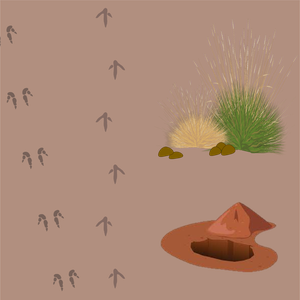


 Tracks of (clockwise from top left) echidna, bird, goanna, bilby and hopping mouse. Credit: Mark Cowan
Why are 2 Ha Plots useful?
- Less stress for animals: 2 Ha Plot surveys don’t involve catching and handling animals. Animals are often stressed if they are caught …
Primary sources
This landing page was developing using the following sources:
Primary sources
This landing page was developing using the following sources:
- NESP Threatened Species Recovery Hub (2021). Arid Zone Monitoring Species Profile: Gould’s goanna. (Project 3.2.5 findings factsheet). https://www.nespthreatenedspecies.edu.au/publications-and-tools/arid-zone-monitoring-species-profiles
- Craig, M., Doughty, P. & Melville, J. 2018. Varanus gouldii. The IUCN Red List of Threatened Species 2018: e.T83778110A101752320. https://dx.doi.org/10.2305/IUCN.UK.2018-1.RLTS.T83778110A101752320.en.
- Wilson, S. & Swan, G. (2017). A Complete Guide to Reptiles of Australia (5th ed). New Holland Publishers: Sydney. Pp. 464